
AI-native roadmap
What "AI-Native" Actually Means, Beyond the Buzzword
Using a coding assistant isn't the same as being AI-native. Here's the concrete test that tells the two apart, and why the difference matters.
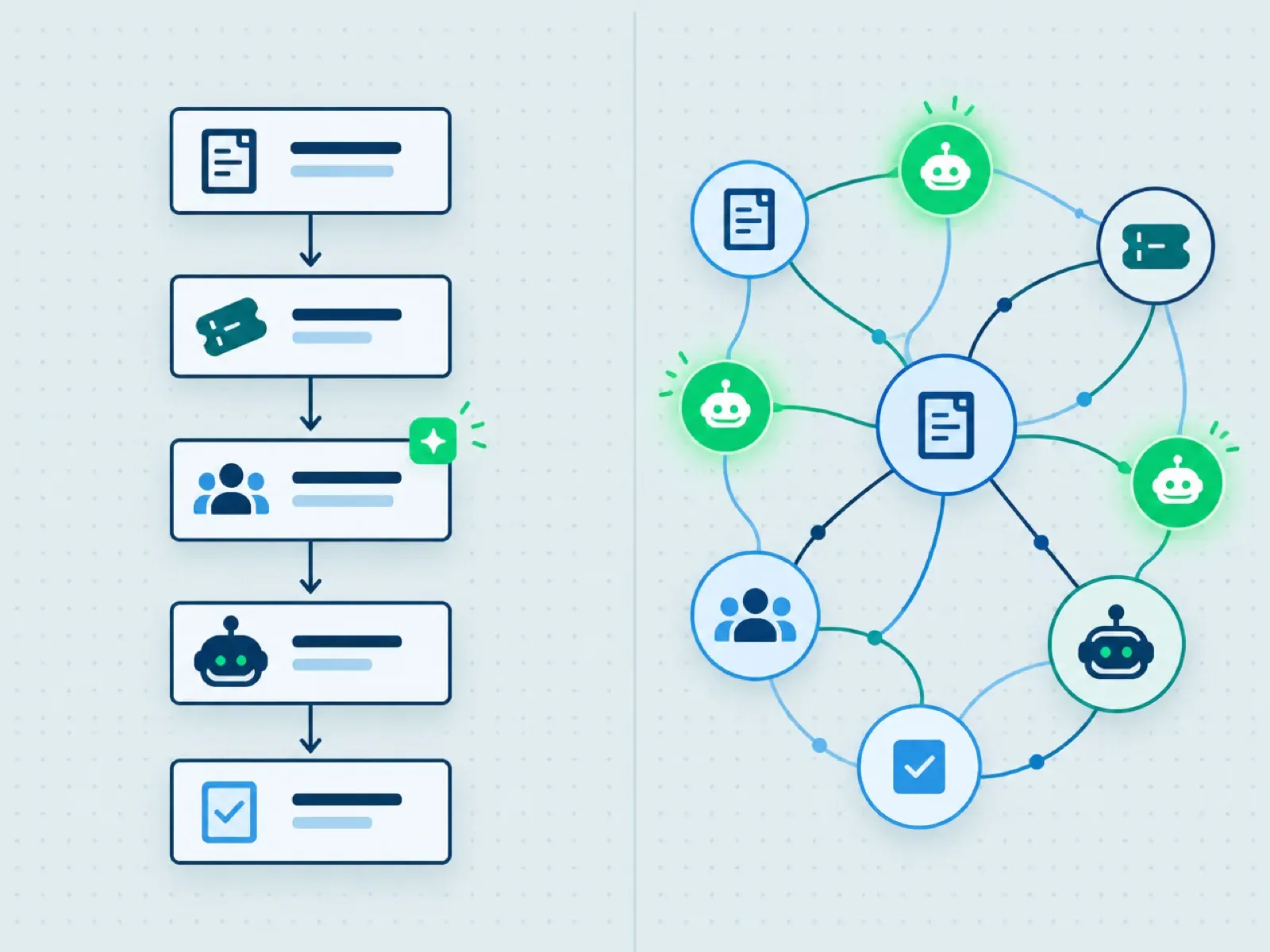
Two engineering teams, same size, both say they’ve “gone AI-native” this year. One added a coding assistant to each engineer’s editor and a chatbot to the support queue. The other changed how specs get written, how tickets stay current, and what an agent is allowed to do without a person checking first. Only one of those teams would still recognize itself if you took the AI tools away tomorrow.
That’s the actual test. AI-native means a team has changed how it works around AI tools and agents, not just added them on top of an unchanged process. The test is whether removing the AI tools would break how the team actually operates, not just whether they use one. It’s a useful distinction, and a mostly missing one: “AI-native” gets used constantly right now to describe both of the teams above, even though only one of them meets it.
What does “AI-native” actually mean, beyond the buzzword?
It means the workflow itself was restructured around AI participating in the work, not that AI got layered onto a process that would run the same way without it. A team using a coding assistant to write functions faster, while specs, reviews, and status updates all still happen exactly as they did two years ago, is using AI. It isn’t AI-native. The tools are a convenience sitting on top of an unchanged process, and the process would survive their removal basically intact, just slower.
An AI-native team looks different structurally, not just in tool count. Specs get written knowing an agent will read and act on them, not just a person. Status has to stay current because an agent, not only a teammate, is working from it in real time. The review process assumes some volume of proposed changes will come from agents, not exclusively from people typing code by hand. Take the tools away from that team and the workflow actually breaks, because the workflow was built assuming they’d be there.
What’s the concrete test for telling the two apart?
Would removing the AI tools break how the team works, or just remove a convenience? That single question sorts most teams cleanly. An AI-adopting team loses some speed and comfort when the tools go away, but the underlying process, who writes what, who reviews what, how status gets tracked, keeps running the same shape it always did. An AI-native team loses something structural: a process that assumed an agent would read a spec and act on it, or that status would stay current because an agent depends on it, doesn’t have an obvious fallback. It has to be rebuilt, not just slowed down.
This lines up with how the distinction gets drawn elsewhere in the same conversation: the difference isn’t whether AI participates somewhere in the business, it’s whether the operating model was actually designed on the assumption that AI would be doing real work inside it, not bolted onto an operating model that was designed without that assumption and never revisited. A chatbot answering support tickets faster is embedded AI. A support process that assumes an agent handles the first pass and a person only sees what needs judgment is a different, more structural thing.
Two teams, one year later
Team one bolted AI on. Roughly fifteen engineers, a coding assistant in every editor, a support chatbot, and an internal wiki everyone was told to “ask AI questions in” instead of Slack-searching. A year later: specs are still written the way they always were, reviewed by the same two senior engineers, updated only when someone remembers to. The coding assistant writes functions faster. Nothing about who decides what, who reviews what, or how status gets tracked changed at all. If the assistant went away tomorrow, the team would be annoyed and slower. It would not be confused about how to work.
Team two restructured around a shared source. Similar size, similar starting point. Instead of adding tools on top, they changed what a spec is for: something both a person and an agent read and act on, kept current as decisions change, not a document written once and left to go stale. Status updates aren’t a separate ritual anymore; they’re a byproduct of the same record an agent is already working from. A blocker raised in a meeting shows up in the ticket the same day, because the ticket isn’t a snapshot from whenever someone last opened it, it’s connected to where the decision actually happened. Take the agents away from this team and there’s a real gap: the process assumed they’d be reading and acting on that shared record, and now nobody’s doing that part.
Both teams would describe themselves as “AI-native” in a sales conversation. Only the second one would pass the test.
What does AI-native actually require, structurally?
A shared, checked source that both people and agents work from, not five individual tool subscriptions that never talk to each other. That’s the part that’s easy to skip, because it doesn’t show up on a tool inventory. A team can have a coding assistant, a chatbot, and an AI meeting notetaker and still have each one working from its own narrow slice of context, with no shared record connecting what one tool knows to what another one does. Adding a fourth tool to that pile doesn’t make the team more AI-native. It adds another disconnected slice.
What actually changes the picture is a record both humans and agents read the same version of: what’s true right now, what’s been decided, what’s stale. Without that, every tool is reconstructing its own partial picture of reality every time it’s asked a question, and an agent working from a stale doc produces confidently wrong output no matter how good the model behind it is.
What’s a concrete marker that separates the two in practice?
Whether tickets, specs, and status stay current for both a human reader and an agent reader, or only look current to whoever wrote them last. On an AI-adopting team, a ticket gets updated when a person remembers to, which is often, but not reliably, especially once a decision changes somewhere other than the ticket itself, in a meeting, a Slack thread, a hallway conversation. An agent reading that ticket has no way to know it’s stale. It executes exactly what’s written, wrong parts included.
On an AI-native team, keeping that record current isn’t an extra chore layered on top of the real work, it’s treated as part of the work, because an agent is depending on it being right, not just a person who might happen to remember the update anyway. That’s a genuinely different discipline, not a bigger tool budget.
| AI-adopting | AI-native |
|---|---|
| Tools added to speed up an unchanged process | Workflow restructured around a shared source both people and agents use |
| Specs and tickets updated when someone remembers | Specs and tickets stay current because an agent depends on them |
| Removing the tools: slower, same process | Removing the tools: the process itself has a gap |
| Each tool works from its own narrow context | One shared, checked record every tool reads from |
Why does this distinction matter for evaluating a vendor or a practice?
Because “AI-powered” as a label says nothing about which side of this line a product, or a team, actually sits on. Plenty of tools genuinely help a team move faster without changing anything structural about how that team decides, tracks, or reviews work, and that’s a fine thing for a tool to be. The problem is treating “AI-powered” as evidence of AI-native maturity, when it’s really just evidence that AI got added somewhere. A team evaluating its own progress, or a buyer evaluating a vendor, gets a much clearer answer from the removal test than from a features list: would taking this away break how we actually operate, or just make us slower at the same thing we were already doing?
Where does Thor fit into this definition specifically?
Thor is the context infrastructure for AI-native software teams, a living model of what’s true that turns conversation into approved action. That’s not a separate claim from the definition above, it’s what makes the “shared, checked source” requirement real instead of aspirational. A team can decide it wants specs and status that stay current for both people and agents; actually building and maintaining that record by hand is the part most teams underestimate, and it’s the specific gap Thor is built to close. Whether that shared record lives inside the context layer a team builds for its agents or shows up as the day-to-day discipline of keeping tickets and specs honest, the underlying requirement is the same one this post has been describing throughout: one answer both humans and agents can actually trust, not a pile of tools each working from their own guess.
FAQ
Is using a coding assistant enough to call a team AI-native?
No. Using a tool is AI adoption. AI-native describes a workflow that was restructured around AI participating in real work, not just sped up by a tool sitting on top of the same process.
What’s the fastest way to check where a team actually stands?
Ask what would break if the AI tools disappeared tomorrow. If the answer is “we’d be slower doing the same things,” that’s AI-adopting. If the answer involves a real gap in the process itself, that’s a marker of AI-native.
Does a team need to be AI-native to benefit from AI tools?
No. Plenty of real value comes from tools that speed up an unchanged process. The distinction matters for knowing which kind of value you’re getting, not for saying one is worthless.
Is “AI-native” just a marketing term at this point?
It’s used that way often enough to be worth being skeptical of, which is exactly why a concrete test matters more than the label itself.
How does Thor relate to becoming AI-native?
Thor provides the shared, checked record that a genuinely AI-native workflow depends on, so specs, tickets, and status stay current for both human and agent readers instead of each tool working from its own partial picture.
See what an AI-native roadmap health check would surface for your team. Try Thor free.
Related Posts

What Happens When Two Coding Agents Get Different Answers
Agent A read the doc. Agent B read the ticket. Both were right once. Here's why neither one knows it's now wrong.
Does a Bigger Context Window Solve the Context Problem?
More tokens means an agent reads more, not that it knows which of what it read is still true. Here's why the two get confused.
What to Ask Thor Your First Week
Three real questions to ask Thor in Slack this week, and what each one gets you back.